 This beautiful book is a Caldecott Medal winner is based on a Yiddish folksong, “Hob Ich Mir a Mantl”. I read it to my preschoolers and kindergartners and got a wonderful response. This book is not only set apart because of its beautiful, colorful illustrations but because of the cutouts that show how Joseph creatively uses his old overcoat as it shrinks to a button and then, finally, to nothing. “Joseph had a a little overcoat. It was old and worn. So he made a jacket out of it.” My favorite message is on the last page. When Joseph finally loses the small button he’s made out of the remains of his overcoat, he says, “So Joseph made a book about it. Which shows…that you can always make something out of nothing.” A great message and a beautiful book for little ones.
Award Winners
All posts in the Award Winners category
Bomb! The Race to Build – and Steal – the World’s Most Dangerous Weapon
Published December 28, 2012 by Dagmar Moving from the recruitment of Robert Oppenheimer to the building of Los Alamos to the testing of the bombs and Hiroshima and the eventual arms race between the United States and the Soviet Union, this excellent non-fiction book cleverly interweaves three story lines. The first is the Americans’ attempt to build the atomic bomb. The second is the Soviets’ attempt to steal the plans for the bomb. The third is an attack on Germany’s heavy water plants in an attempt to prevent Hitler from building an atomic bomb. Full of material that illuminates a period of history few middle school and high school students may be familiar with, this engaging read will keep them interested. I’ve also recommended it to adults, because it provides real insight into the scientists that built the bomb, their motivations for building it and the motivations of some scientists to ensure that the United States wasn’t the only country in the world with this most powerful weapon. Photographs are included.
Winner of YALSA Award for Excellence in Non-fiction for Young Adults, the Silbert Medal, a Newbery honor and a National Book Award finalist.
Inside Out and Back Again, by Thanhha Lai
Published December 5, 2012 by Dagmar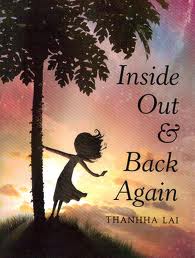 Recently, there have been a lot of novels written in verse. I like the format and found a few books that I really enjoyed. Here is one that I loved. I thought the diary format and verse helped lighten the difficult issues the main character faces. Short chapters also make it very attractive to reluctant readers. One such reader in my library returned it to me, then promptly checked it out again, because she loved it so much.
Synopsis: This semi-autobiographical novel tells the story of Ha, a 10 year old girl living with her family in South Vietnam during the Vietnam War. Her father is a member of the South Vietnamese navy and is missing in action. Ha lives alone with her mother and brothers. Ha longs for the papayas to ripen on her papaya tree and hopes that her father will return from his mission so that her mother can smile. The family reluctantly leaves South Vietnam with their uncle on a South Vietnamese navy ship. Conditions are terrible on the ship. Everyone is hungry until a U.S. Navy ship arrives, providing food and a tow to a refugee camp in Guam. The family is asked to choose a country where they would like to live. Ha’s mother chooses the United States. Sponsored by a family in Alabama, and dependent on the charity of others, Ha deals with being different struggles learning English.
This book won a Newbery Honor in 2012.
Moon Over Manifest, by Clare Vanderpool
Published November 10, 2012 by Dagmar Moon Over Manifest won the Newbery Award in 2011. This book combines a compelling mystery with wonderful characters. It is filled because with poignant stories of a small town of people pulling together in the face of hardship, friendship and a parent’s love for their child. Highly recommended for middle readers or as a read aloud for fourth or fifth grade.
Synopsis: Moon Over Manifest is the story about a 12 year old girl who lands in a small Kansas town called Manifest in 1936 after traveling as a drifter with her father for years. She wants to learn about her father’ time in Manifest, where he spent time as a boy. Her story in 1936 is cleverly woven together with the town’s history from 1918, which she hears through the stories of an old Hungarian woman, other towns’ people and newspaper articles.
 Kids' Lit Corner