3rd grade read aloud

All posts in the 3rd grade read aloud category

The Mountain that Loved a Bird, by Alice McLerran

Published January 24, 2014 by Dagmar

themountainthatlovedI was drawn to this book because of Eric Carle’s illustrations.  As I read The Mountain that Loved a Bird, I really fell in love with it, as did my students.  It’s a book filled with longing, friendship and dedication.

Joy is a bird that lands on the side of a mountain.  The mountain is lonely.  When it hears Joy’s beautiful singing it asks her to stay.  Joy says that she can not stay, because there is no food or water for her on the mountain.  She says that she’ll return every year to visit and sing to the mountain.  She also says that she’ll name her daughter Joy and her daughter will name her daughter Joy so that every year bird named Joy will visit the mountain to sing to it.  Each year, Joy returns and each year, the mountain begs Joy to leave and is sad when it’s time for Joy to leave.  One year, the mountain is so sad that it cries, and a stream of tears starts running down the mountain.  The next year, Joy brings a seed with her and drops it near the stream.  Over the course of years, the seed grows roots and draws water from the cracks deep within the mountain.  Soon, more plants grow, and the mountain’s tears of sadness grow into tears of happiness at everything growing around the mountain.  The book closes with Joy bringing a twig to begin her nest on the mountain. She tells the mountain, finally, that she is there to stay.

This is such a beautiful book.  I hope you enjoy it.
My Brother Martin, by Christine King Farris

Published January 17, 2014 by Dagmar

my brother martinI have some favorite books to read when celebrating Dr. Martin Luther King Jr.’s birthday and his tremendous life.  One, is Martin’s Big Words, by Doreen Rappaport.  Like me, most teachers love Martin’s Big Words as well.  So finding something different but accessible to young audiences is a always a challenge for me in the library.

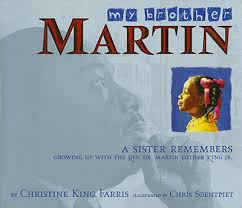
Here is a book that I discovered this year that I love for younger audiences.  Published in 2006, it provides a different perspective on this great man’s life that students haven’t heard before.  When I introduce this book to my students, I remind them that before Dr. King became “Dr. King”, he was a child just like them.  My Brother Martin was written by Christine King Farris, Dr. King’s older sister.

In My Brother Martin, Ms. King Farris tells of Dr. King’s childhood on Auburn Street in Atlanta, Georgia.  There are funny pranks that the children, Christine, M.L. (Martin Luther) and their younger brother A.D. (Alfred Daniel) played on neighbors and their piano teacher.  These stories made all my students smile.  Ms. King Farris also tells of the painful time when the children of a white store owner on their street were no longer allowed to play with Negroes (a word I had to explain to my younger students).  The white family sold their store and moved away.  After years of shielding their children from the injustice and cruelty dealt to black people, this episode brought all that home.  Christine, M.L. and A.D. were confused about why their friends would no longer play with them.  Their mother explained about all the “Whites Only” signs.  She also told her children that this injustice was there, “Because they just don’t understand that everyone is the same, but someday, it will be better.”  M.L. then replied, “Mother Dear, one day I’m going to turn this world upside down.”  And that he did.

M.L. and his sister and brother now were aware of segregation.  They watched as their father, a minister at Ebenezer Baptist Church spoke out against it and how he practiced what he preached.  Their father did not allow others to treat him differently because of his skin color and took his business elsewhere when store owners did.  Their parents’ example and the pain of their childhood friends’ leaving provided the inspiration for Dr. King’s pursuit of justice.

This is a heartening and inspiring story of Dr. King that provides insights other books don’t provide.  I highly recommend it to elementary school audiences.  The illustrations by Chris Soentpiet are wonderful.

Wild Horse Winter, by Tetsuya Honda

Published December 6, 2013 by Dagmar

wildhorseThis book was a sleeper, sitting for the last three years in a paperback picture book basket.  As I flipped through my basket, organizing books one day, I was intrigued by this book.  You may have read that my first grade students board my library plane each week, taking trips to different continents and countries.  Thinking that this book took place in Wyoming or Colorado, I was already to break out my state books.  The fact that I was rushed and hadn’t read the book before I decided to read it to my students was quickly discovered as the horses in the book inexplicably reached the ocean.  Last time I heard, there are no oceans in Colorado.  My very forgiving students were happy to re-board our plane and head West, all the way across the Pacific Ocean to the island of Hokkaido in Japan.

This beautifully illustrated book by Tetsuya Honda is about the wild horses that live on the island of Hokkaido in Japan.  These horses, according to the author’s note, were brought to the island of Hokkaido three hundred years ago, by merchants and fisherman.  In the winters, the merchants and fisherman would abandon the island to go to the mainland, but left their horses to survive the harsh winter on the island.  In this story, we see a colt and his mother brave the winter by sleeping in a snow drift as they try to find their way from the grassy inland to the ocean.  According to the author, Dosanko horses are known to lie down close to the ground and allow the snow to cover them in an effort to stay warm.  Over many years, yhe horses, known as Dosanko horses, adapted to the harsh winters gradually developing longer hair, shorter bodies and stronger hooves. There are now only about 1,000 of these horses, living mostly on wild horse preserves.

This book was a jumping off point for lots of discussion: about Japan, how animals adapt to harsh conditions, how the native tribes near the arctic circle sometimes use ice to build homes to stay warm and how you might stay warm if caught in a blizzard or avalanche.

The book really captivated my students.  I recommend it for first through third grade audiences, or younger audiences at home.

Nelson Mandela, by Kadir Nelson

Published December 6, 2013 by Dagmar

mandelaYesterday, Nelson Mandela passed away.  He fought for freedom and won it for his people.  He was a tremendous man.  He lived 95 years and is a symbol of the power of protest for so many around the world.  President Obama said, “Let us pause and give thanks for the fact that Nelson Mandela lived–a man who took history in his hands and bent the arc of the moral universe toward justice.”

How lucky for us that we have Kadir Nelson’s beautiful picture book about Nelson Mandela to help children understand the life and work of Nelson Mandela.  The book, written in verse, leads the reader through Nelson Mandela’s life from the time he was a child through the end of apartheid and his election as South Africa’s first black president.  The illustrations are full-page and incredible in the way that they capture the emotion of each scene.

On the back cover of the book, the author says, “My work is all about healing and giving people a sense of hope and nobility.  I want to show the strength and integrity of the human being and the human spirit.”  He certainly succeeded in this book.

Highly recommended.  Best for third grade and up, but could work for younger students as well.  Thank you to Junior Library Guild for introducing me to this book.

Richard Wright and the Library Card, by William Miller

Published July 23, 2013 by Dagmar

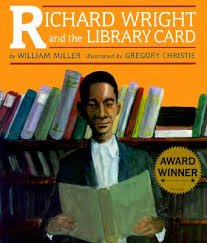
richard wrightThis book is a great read aloud for African-American history month.  I plan to use it with my third and fourth graders.  The illustrations by Gregory Christie are excellent.

Richard Wright loved to read but had no access to books as a child or as a young man.  He would read scraps of newspaper or whatever words he could find.  When Richard finds work at an optician’s office, he notices that one of the white men there seems different – as he would understand Richard’s need for books.  Richard gathers his courage and asks the man if he can use the man’s library card.  When Richard goes to the public library.  When the librarian questions him about the books he is checking out, Richard lies to her and tells her that he can’t read.  He tells her that he is just picking up books for the card’s owner.  White people in the library snicker at him.

This is the fictionalized account of an important episode in Richard Wright’s life, written about in Wright’s famous autobiography, Black Boy, published in 1945.  Highly recommended.

Don’t Let the Pigeon Drive the Bus, by Mo Willems

Published June 26, 2013 by Dagmar

Pigeon busWhatever you do, DON’T let the pigeon drive the bus.  Mo Willems has a great sense of humor, and this book is simply hilarious.  There is not one class, pre-k through 5, that doesn’t laugh hysterically when I read this book.

Pigeon really wants to drive the bus.  But, the only thing the bus driver as asked you to do is NOT let pigeon drive the bus.  Sounds easy, right?  Well, pigeon really, really wants to drive this bus.  He’ll tell you just about anything to get to drive the bus.  Any adult that’s been around a child will recognize Pigeon’s ploys as he tries to cajole you into letting him drive the bus.

Enjoy!  You may just be laughing as loud as the children around you.

This book won a Caldecott Honor in 2004.

Big Mean Mike, by Michelle Knudsen

Published June 8, 2013 by Dagmar

Big Mean MikeWow did my students love this book!  It’s a lot of fun, and the illustrations by Scott Magoon are great.

“Big Mean Mike was the biggest, toughest dog in the whole neighborhood.”  He has the meanest looking car and really mean looking combat boots.  When he opens his trunk to put in a package, there is a bunny – a really, really cute little bunny.  Nothing is less big and mean than a really, really cute bunny.  Big Mean Mike, puts it on the ground and drives away.  The next day, the cute bunny is back with a friend.  Big Mean Mike again leaves the bunnies on the sidewalk and drives away.  This continues until the day that Big Mean Mike goes to the monster truck show.  He then finds four really adorable bunnies under the driver’s seat of the car.  He leaves them in the car to go into the truck show, but then just can’t leave those incredibly cute bunnies in the car.  So, he sneaks them into the monster truck show.  Eventually, he can’t resist their cuteness and lets them out of their bag to watch the show.  As you might suspect, the other dogs tease him when they seem Big Mean Mike with four little bunnies.  This is the best part of the book… The bunnies growl back at the dogs that are teasing Big Mean Mike.  Then, Big Mean Mike tells those dogs that he can be friends with whomever he wants.

This book is so great.  I love the Big Mean Mike has a soft side and that he’ll stick up for himself when he does something that other dogs would be afraid to do.  Go Big Mean Mike!  Go Bunnies!

The Paper Crane, by Molly Bang

Published June 5, 2013 by Dagmar

the paper craneThis book never fails to please my students.  I usually read it to second or third graders, but it can be enjoyed by older students as well.

This is a story of a man who owned a restaurant on a busy road.  He loved owning his restaurant and had many customers, until a new highway was built.  Travelers no longer passed by, and the restaurant was empty.  One evening, a stranger wearing old and worn clothes comes to the restaurant.  Although the restaurant owner is very poor, he feeds the stranger. The stranger repays the kindness of the restaurant owner by folding a napkin into a paper crane.  He tells the restaurant owner that when he claps his hands, the crane will come to life and dance.  Sure enough, it works.  The crane dances.  People come from all around to see the dancing crane and soon the restaurant is busy again. One day, the stranger returns and takes out a flute.  The crane comes to life and goes to him.  Together, they leave the restaurant.  The stranger and his crane are never seen again, but travelers still come to the restaurant to hear the story of the stranger and the crane.

The illustrations are cut paper collage.  This book is the winner of the Boston Globe-Horn Book Award for illustration (1986).

Velma Gratch & the Way Cool Butterfly by Alan Madison

Published June 1, 2013 by Dagmar

the way cool butterflyVelma is in first grade.  Unfortunately, Velma is the third of the Gratch sisters.  Even more unfortunately, both of Velma’s older sisters were incredibly memorable.  They were perfect.  Velma is constantly reminded of how wonderful her sisters were while no one seems to remember her name.  Velma decides she wants to be remembered, too.

When Velma’s class goes on a field trip to the butterfly conservatory, Velma finds out that her sisters never went there.  Velma waits and waits for something memorable to happen to her at the conservatory.  Then, something does.  A beautiful monarch butterfly lands on her finger…and stays there.  The butterfly stays and stays on Velma’s finger long after they’ve left the conservatory.  Finally, Velma’s principal says, “no one will forget this.”  Velma realizes that monarch needs to start its “my-gray-sun”.  Velma knows just how to make the monarch leave her finger and takes her monarch to the park.

This book drew applause from my second graders.  It’s a great story about rooting for the underdog.  The illustrations by Kevin Hawkes are really nice.  This was chosen as a School Library Journal Best Book of the Year.

Of Thee I sing, by Barack Obama

Published May 30, 2013 by Dagmar

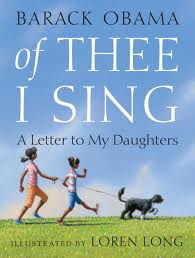
of theeI find this book incredibly inspiring.  Many thanks to Amelie’s Bookshelf for the recommendation.  I went out and bought it and used it for my final week of library classes.  I read it to students in grades 1-5.

President Obama’s book is a letter to his daughters about the people that made our country wonderful.  He starts, by saying, “Have I told you that you’re creative?” and then talks about Georgia O’Keefe.  Each page, he talks about a quality exemplified by the person he highlights, including Helen Keller, Cesar Chavez, Neil Armstrong, Jackie Robinson, Martin Luther King, Jane Addams, Abraham Lincoln, Maya Lin, Sitting Bull and others.  Some people, like Georgia O’Keefe, Maya Lin, Jane Addams and Helen Keller were less familiar to my students.  It was nice to have the opportunity to talk about these amazing people and the importance of their work.  Most importantly, President Obama finishes the book by saying that America is full of people of all different races, religions and ideas.

This book is a beautiful, touching book.  It’s especially great to share.  The illustrations by Loren Long are wonderful.  My students quietly while I read the book to them (good quiet, not bored quiet).  Afterward, we went from student to student and talked about which person or people inspired them the most.  I loved hearing students talk about the people that inspired them, particularly when they mentioned people they’d first learned about in the book.