Read alouds for older students

All posts in the Read alouds for older students category

Nelson Mandela, by Kadir Nelson

Published December 6, 2013 by Dagmar

mandelaYesterday, Nelson Mandela passed away.  He fought for freedom and won it for his people.  He was a tremendous man.  He lived 95 years and is a symbol of the power of protest for so many around the world.  President Obama said, “Let us pause and give thanks for the fact that Nelson Mandela lived–a man who took history in his hands and bent the arc of the moral universe toward justice.”

How lucky for us that we have Kadir Nelson’s beautiful picture book about Nelson Mandela to help children understand the life and work of Nelson Mandela.  The book, written in verse, leads the reader through Nelson Mandela’s life from the time he was a child through the end of apartheid and his election as South Africa’s first black president.  The illustrations are full-page and incredible in the way that they capture the emotion of each scene.

On the back cover of the book, the author says, “My work is all about healing and giving people a sense of hope and nobility.  I want to show the strength and integrity of the human being and the human spirit.”  He certainly succeeded in this book.

Highly recommended.  Best for third grade and up, but could work for younger students as well.  Thank you to Junior Library Guild for introducing me to this book.

The Girl Who Spun Gold, by Virginia Hamilton

Published October 18, 2013 by Dagmar

thegirlwhospungoldRumpelstiltskin is a favorite Grimm’s fairytale.  The Girl Who Spun Gold, by Virginia Hamilton retells the story in a West Indian setting. This refreshing version captivated my fourth graders not only because of Hamilton’s writing, but particularly because of Leo and Diane Dillon absolutely captivating, colorful illustrations.  Hamilton read a version of this tale in West Indian dialect in 1899.  While she loved the retelling, she found it hard for modern audiences to understand.  So, she re-wrote it in more familiar language.  The version is long and took longer than one class time to complete, but was well worth the time.  Click here to see a lesson idea comparing two different retellings of the Rumplestiltskin story using this book.

Lesson idea: The Girl Who Spun Gold and Rumplestiltskin

Published October 18, 2013 by Dagmar

Here’s a lesson idea, contrasting two different retellings of a fairy tale, that worked really well with my fourth graders.  I love the book The Girl Who Spun Gold, by Virginia Hamilton and wanted to pair it with the traditional telling of Rumplestiltskin.  I used a very old copy of Rumplestiltskin thegirlwhospungoldthat we had in our library.  I wasn’t thrilled with this older book and ordered Paul Zelinsky’s version of the book after this lesson (winner of the 1987 Caldecott Honor).  The illlustrations are full of vibrant color that are sure to attract students and compare nicely with Leo and rumplestiltskinDiane’s illustrations in The Girl Who Spun Gold.

I took two class times to read Virginia Hamilton’s book, about 20 minutes, in all.  I then read the traditional telling of the story.  My students were jumping up to offer me similarities and differences between the two retellings of the story.  It was a lot of fun to see them so excited.

Next week, I’ll do a book talk and read the first couple of chapters of Rump: The True Story of Rumplestiltskin, a new book by Liesl Shurtliff, a fractured fairytale.

Richard Wright and the Library Card, by William Miller

Published July 23, 2013 by Dagmar

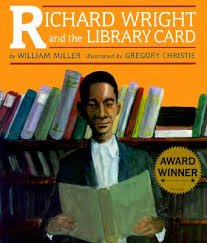
richard wrightThis book is a great read aloud for African-American history month.  I plan to use it with my third and fourth graders.  The illustrations by Gregory Christie are excellent.

Richard Wright loved to read but had no access to books as a child or as a young man.  He would read scraps of newspaper or whatever words he could find.  When Richard finds work at an optician’s office, he notices that one of the white men there seems different – as he would understand Richard’s need for books.  Richard gathers his courage and asks the man if he can use the man’s library card.  When Richard goes to the public library.  When the librarian questions him about the books he is checking out, Richard lies to her and tells her that he can’t read.  He tells her that he is just picking up books for the card’s owner.  White people in the library snicker at him.

This is the fictionalized account of an important episode in Richard Wright’s life, written about in Wright’s famous autobiography, Black Boy, published in 1945.  Highly recommended.

Women of Hope: African Americans who Made a Difference, by Joyce Hansen

Published June 30, 2013 by Dagmar

Women of HopeI love to read parts of this book aloud to my students during African-American history month.  This book features quotes, black and white photographs and a page about many notable African-American women, including: Ida B. Wells-Barnett, The Delany Sisters, Septima Poinsette Clark, Ella Josephine Baker, Fannie Lou Hamer, Ruby Dee, Maya Angelou, Toni Morrison, Marian Wright Eledman, Alica Walker, Alexa Canady, Mae C. Jemison with a list of more notable women in the back of the book.

This book makes a great resource for teachers or a wonderfully inspiring book for young people.  Read a page here and there, or read the entire book.  Either way, don’t miss it.

Of Thee I sing, by Barack Obama

Published May 30, 2013 by Dagmar

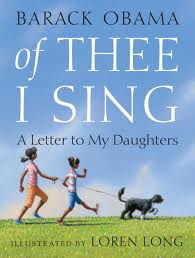
of theeI find this book incredibly inspiring.  Many thanks to Amelie’s Bookshelf for the recommendation.  I went out and bought it and used it for my final week of library classes.  I read it to students in grades 1-5.

President Obama’s book is a letter to his daughters about the people that made our country wonderful.  He starts, by saying, “Have I told you that you’re creative?” and then talks about Georgia O’Keefe.  Each page, he talks about a quality exemplified by the person he highlights, including Helen Keller, Cesar Chavez, Neil Armstrong, Jackie Robinson, Martin Luther King, Jane Addams, Abraham Lincoln, Maya Lin, Sitting Bull and others.  Some people, like Georgia O’Keefe, Maya Lin, Jane Addams and Helen Keller were less familiar to my students.  It was nice to have the opportunity to talk about these amazing people and the importance of their work.  Most importantly, President Obama finishes the book by saying that America is full of people of all different races, religions and ideas.

This book is a beautiful, touching book.  It’s especially great to share.  The illustrations by Loren Long are wonderful.  My students quietly while I read the book to them (good quiet, not bored quiet).  Afterward, we went from student to student and talked about which person or people inspired them the most.  I loved hearing students talk about the people that inspired them, particularly when they mentioned people they’d first learned about in the book.

This is Not My Hat, by Jon Klassen

Published May 24, 2013 by Dagmar

This is not my hatHere is another fabulous picture book by Jon Klassen, the author of the very the very funny I Want My Hat Back.  I love the dark, dry humor in this and I Want My Hat Back.

A little fish has taken a very big fishes’ hat.  He swims confidently to the place where the plants grow big and tall and close together.  He is sure that the big fish will not know where he is and that the crab that saw him swim by will not tell the big fish where to find him.  Oops.  This book has great pacing and is perfect for my “too old for picture books” students.  They love it as do I.

Jon Klassen is also the illustrator of Extra Yarn by Mac Barnett, one of my favorite picture books.  C

Chopsticks, by Amy Drouse Rosenthal

Published May 22, 2013 by Dagmar

chopsticks A pair of chopsticks have been friends forever; in fact, they are inseparable, until one day while karate chopping a spear of asparagus, one chopstick breaks.  He is “whisked” away to recuperate.  His chopstick friend never leaves his sick friend’s side until one day, the hurt chopstick urges his best friend to venture out alone, as a single chopstick.  Unsure of himself, the healthy chopstick begins to find new things to do.  He learns that he can test muffins to see if they’re done, play pick up sticks with a set of pick up sticks, direct a band and pole vault over cookbooks.  In fact, he becomes stronger without his best friend.  Then, when his best friend has healed, they realize that, together, they have so many new things to share.  Knife called for a “toast”.  This book has the double entre that older readers just love.  It’s a story of friendship – a funny one.  Great illustrations by Scott Magoon.  Enjoy!

Keeper of Soles, by Teresa Bateman

Published May 13, 2013 by Dagmar

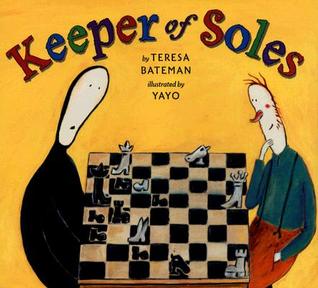
I’ve read thikeeperofsoless book to fourth grade through sixth grade audiences.  I love the double entendre as well as the great illustrations by Yayo.  Clever and funny, this book is wonderful for older audiences.

The Grim Reaper appears at a shoemaker’s door one night asking for the shoemaker’s soul.  As any good shoemaker would do, the shoemaker looked at Death’s feet and noticed that Death was barefoot.  Cleverly, the shoemaker suggests a pair of sandals to cover Death’s feet.  Snatching Death’s scroll of names out of his hand, the shoemakers sketches a pattern and says he’ll see Death in four weeks.  This so confuses Death, that he goes along with the plan.  He appears year after year, each time getting more and more shoes for his wardrobe until Death finally announces that he has come for the shoemaker’s soul and won’t be denied.  The shoemaker cleverly points out that he has given Death sole after sole.

Langston’s Train Ride, by Robert Burleigh

Published May 11, 2013 by Dagmar

S640SchLangstonjkt_0.tifThis is another wonderful book for African-American History month.  Langston’s Train Ride begins with Langston Hughes walking down a sidewalk celebrating the publishing of his first book of poems.  He then flashes back to the train ride he took to Mexico to see his father when he was 18 years old.  As the train travels, he reminisces about his childhood.  When the train crosses the Mississippi River, he thinks of what it means to his people, the slaves who were sent “down the river” and Abe Lincoln’s trip on the river “where he saw a slave auction and learned to hate slavery.”  His view of the Mississippi brings words to his head.  He thinks of other ancient rivers in Africa and begins to write down the words to his first poem: “The Negro Speaks of Rivers.”

This is a powerful book made more so by its incredible illustrations by Leonard Jenkins.  It is hard not to be moved by this book and the words of Langston Hughes’ first poem.