Children’s Book Recommendations

All posts tagged Children’s Book Recommendations

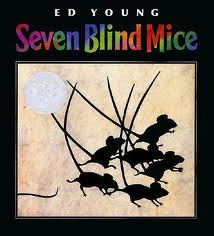
Seven Blind Mice, by Ed Young

Published July 2, 2013 by Dagmar

seven blind miceThis Caldecott Honor book is a favorite with my young readers.  I usually read it to pre-k through 1st grade.  The colors are brilliant, set on a black background.

Seven mice, red, green, yellow, purple, orange, blue and white, try to understand the large object in front of them.  Each one feels a different part of the whole and makes a guess as to what the object must be.  It isn’t until the seventh mouse runs “up one side, down another and across the Something from end to end” that he discovers that the “Something” is an elephant.  The others, then do the same and agree with the white mouse.   The moral? “Knowing in part may make a fine tale, but wisdom comes from seeing the whole.”

Women of Hope: African Americans who Made a Difference, by Joyce Hansen

Published June 30, 2013 by Dagmar

Women of HopeI love to read parts of this book aloud to my students during African-American history month.  This book features quotes, black and white photographs and a page about many notable African-American women, including: Ida B. Wells-Barnett, The Delany Sisters, Septima Poinsette Clark, Ella Josephine Baker, Fannie Lou Hamer, Ruby Dee, Maya Angelou, Toni Morrison, Marian Wright Eledman, Alica Walker, Alexa Canady, Mae C. Jemison with a list of more notable women in the back of the book.

This book makes a great resource for teachers or a wonderfully inspiring book for young people.  Read a page here and there, or read the entire book.  Either way, don’t miss it.

Titanic: Voices from the Disaster, by Deborah Hopkinson

Published June 28, 2013 by Dagmar

TitanicThe story of the sinking of the Titanic in 1912 on its maiden voyage has fascinated so many.  The Titanic’s story never really captured my attention, but that ended when I listened to the audio version of this book last year.  I decided to read the book myself when I saw the number of pictures and side bars the author included in the book.  Although I liked the audio edition, I think you lose something if you don’t actually read the book.  The additional content is really great.

Titanic: Voices from the Disaster was published in 2012 on the 100th anniversary of the loss of the Titanic at sea.  It tells the story of the Titanic from the time it was built to the day of the disaster and, finally, its discovery at the bottom of the ocean in September 1985.   The author weaves in an incredibly suspenseful story from the recollections and pictures of different survivors, passengers and crew alike, pictures of the Titanic’s incredibly luxurious accommodations and details about the construction of the boat.  I couldn’t put this book down.  It moved quickly, and the side bars and pictures were really interesting.

I’d recommend this book to middle school, high school and adult readers, especially those interested in the story of this great ship.  This book won a 2013 Silbert Medal honor.

Thanks to Junior Library Guild for introducing me to this great book.

The Z was Zapped, by Chris Van Allsburg

Published June 27, 2013 by Dagmar

the z was zappedI’m a fan of Chris Van Allsburg’s work, particularly of The Garden of Abdul Gasazi.  I save most of his books for my older students, so finding a book that my younger students can enjoy is great.  As always, there are incredible black and white illustrations and just a touch of dark humor in the book. This is definitely a different kind of alphabet book. 😉

In the Z was Zapped, the entire alphabet, presented in “a play in 26 acts”, meets its demise on stage.  “The A was in an avalanche.  The B was badly bitten.  The C was cut to ribbons…”  It’s fun watching my students guess at how each letter meets its end.  This was perfect for my 1st graders.

Don’t Let the Pigeon Drive the Bus, by Mo Willems

Published June 26, 2013 by Dagmar

Pigeon busWhatever you do, DON’T let the pigeon drive the bus.  Mo Willems has a great sense of humor, and this book is simply hilarious.  There is not one class, pre-k through 5, that doesn’t laugh hysterically when I read this book.

Pigeon really wants to drive the bus.  But, the only thing the bus driver as asked you to do is NOT let pigeon drive the bus.  Sounds easy, right?  Well, pigeon really, really wants to drive this bus.  He’ll tell you just about anything to get to drive the bus.  Any adult that’s been around a child will recognize Pigeon’s ploys as he tries to cajole you into letting him drive the bus.

Enjoy!  You may just be laughing as loud as the children around you.

This book won a Caldecott Honor in 2004.

The Invention of Hugo Cabret, Brian Selznick

Published June 19, 2013 by Dagmar

hugo cabretThe Invention of Hugo Cabret is very special.  It is unlike any other children’s book I’ve read.  Selznick masterfully intertwines illustration with words to create a captivating story.  When I first opened this book with my son years ago, I was amazed by the illustrations.  As my son and I turned the pages, he was completely taken in by the story, as was I.

This year, I had a student who was reading easy chapter books.  As a very bright fifth grader, I knew he needed to challenge himself with more difficult books.  I suggested this book and watched as it opened up the world of literature for this child.  He devoured the book in two days, brought it back and checked out Wonderstruck, Brian Selznick’s next book.  These two books led him to explore many different books in my library.  I was amazed at this student’s transformation from a child who liked books to a child who became an insatiable reader.

Hugo is an orphan, living in a train station in Paris. Hugo’s father and his uncle had a talent for fixing mechanical things, particularly clocks and taught Hugo their trade.  After Hugo’s uncle passes away,  Hugo hides in the train station in his uncle’s old apartment, maintaining the station clocks in order to fool the station master into believing his uncle is still alive.  But, Hugo has an even bigger secret.  Before he died, Hugo’s father was trying to repair a mechanical man that he and Hugo believed would draw a picture or write a message once he was repaired and able to write again.  Hugo’s one wish is to complete his father’s work and read the mechanical man’s message.   This endeavor leads Hugo to meet new friends and unravel more than the mystery of the message, but the mystery of of the mechanical man and his inventor.

This book won the 2008 Caldecott Medal and is unique and memorable.  It’s perfect for tweens, middle school students and adults.  Don’t miss it.

Flight, edited by Kazu Kibuishi

Published June 18, 2013 by Dagmar

flightFinally, something to satisfy the many Amulet fans in my library.  As I mentioned in my blog article about Amulet, my students are so sad that the series only has five volumes.  Many of my students have read each book of Amulet multiple times.  Kibuishi’s Copper book also circulated like crazy until our copy was lost.

So, when I found out that Kazu Kibuishi created a collection of graphic short stories, I thought I’d give these books a try in my library.  I was not disappointed.  While the work is not entirely that of Kazu Kibuishi exclusively, it is a really nice collection.  It contains short stories from 21 authors, including one story from Kibuishi.  I ordered the first three books, and they immediately started circulating.  There are eight books in all, and I’ve already been asked by my students to add to our collection.  While most of these stories can be understood by younger students, I would recommend them for a tween and older audience.

Patrick’s Dinosaurs, by Carol Carrick

Published June 15, 2013 by Dagmar

Patricks DinosaursThis is a sweet book about a little boy with a vivid imagination.  Great for young dinosaur lovers.

Patrick and his big brother Hank go to the zoo.  When Patrick sees an elephant, he says, “I’ll bet that elephant is the biggest animal in the whole world.”  His brother tells him that “a brontasaurus was heavier than TEN elephants!”  As Hank tells Patrick about prehistoric animals, they all come alive in Patrick’s imagination.  Stegasaurus, Triceratops, Tyrannosaurus Rex.  Luckily, just before Patrick’s imaginary Tyrannosaurus Rex does anything too dangerous, Hank assures him that dinosaurs have long been extinct.  Phew.  Enjoy!

Zeke Meeks, by D.L. Green

Published June 14, 2013 by Dagmar

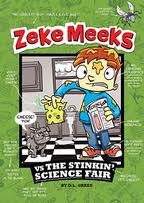
zekemeeksHere’s a series that’s perfect for third and fourth graders that like funny books. Although, of course, books are not written specifically for boys, in my library, this series is checked out almost exclusively by boys. We have some older readers that come back to this series when they want a quick, funny read. Zeke Meeks combines text with pictures and a story line that’s fast moving and is very popular in our library. Be warned that this book definitely makes use the gross humor that is so popular with this age group.

In Zeke Meeks vs. the Stinkin’ Science Fair, third grader, Zeke Meeks, is faced with creating a science fair project. Zeke hates science. So, why is Zeke determined to win the science fair? Grace Chang, a girl with a really bad attitude, has staked out a corner of the playground with her two goons (forgive me), Emma G. and Emma J. She has named that part of the playground Graceville. Zeke makes the mistake of crossing into Graceville uninvited, and Grace knocks him down. When Zeke grabs her backpack to break his fall, it rips. Grace demands that Zeke pay her $50 to replace her ruined backpack. How does a third grader earn $50 — why, by winning the science fair, of course. So begins Zeke and his new friend Hector’s science project adventure and their battle against the vicious and evil Grace.

There are six books in the series, all sure to delight fans of funny books.

Anne Frank: Her life in words and pictures, published by the Anne Frank House

Published June 11, 2013 by Dagmar

Anne FrankMany adults know the story of Anne Frank, the 14 year old girl who died in the Holocaust and whose diary told the story of her family’s ordeal hiding from the Nazis in Holland.  When I was young, we not only read The Diary of a Young Girl, by Anne Frank, we saw the play.  Both the book and the play had a huge impact on me when I saw the play in middle school.

It always surprises me that my students don’t know Anne Frank’s story.  It was heartening to hear the outrage they expressed when they realized that Anne was killed by the Nazis just because she was Jewish.  This injustice touched my students deeply, and this particular book about Anne Frank’s life was in high demand during my sixth grade girls’ biography unit.

This book has a unique format.  Published by the Anne Frank House, this book is six inches square and includes many family photographs of the Frank family.  The beginning of the book shows a picture of the diary that made Anne famous.  It’s a red plaid diary that she chose herself for her 13th birthday.  Pasted inside the front cover is a beautiful picture of Anne on her birthday.  Readers are drawn in by the picture of a young and pretty girl with a big smile.

After the Adolf Hitler and the Nazis came to power, the Frank family decided to leave Germany for Holland in 1933, because of the many restrictions Hitler and the Nazis placed on Jews.  In 1940, the Germans invaded Holland, and life for Jews changed dramatically for the worse.  In 1942, the Frank family went into hiding with the van Pels at Otto Frank’s office.  In June 1944, the Frank family celebrated as Allied troops landed at Normandy; but, in August, their dreams were shattered as they were captured by the Nazis and sent to different work and extermination camps.

I think this book was so successful with my students because Anne’s family’s story is interwoven with Anne’s own words from her diary.  There are many pictures of where Anne’s family and the van Pels family hid, so young readers can really get a sense of what Anne might have experienced as she hid from the Nazis.  Pictures of her diary pages are scattered throughout the book. This book brings the story of the Holocaust to a whole new generation very effectively.

Anne Frank and her sister Margot were sent to Bergen-Belsen camp.  The only member of the Frank and van Pels families to survive the war was Anne’s father Otto, who was liberated at Auschwitz by the Russians.

This is a powerful book and highly recommended.  This book was a Junior Library Guild selection.