2nd grade read aloud

All posts in the 2nd grade read aloud category

Wild Horse Winter, by Tetsuya Honda

Published December 6, 2013 by Dagmar

wildhorseThis book was a sleeper, sitting for the last three years in a paperback picture book basket.  As I flipped through my basket, organizing books one day, I was intrigued by this book.  You may have read that my first grade students board my library plane each week, taking trips to different continents and countries.  Thinking that this book took place in Wyoming or Colorado, I was already to break out my state books.  The fact that I was rushed and hadn’t read the book before I decided to read it to my students was quickly discovered as the horses in the book inexplicably reached the ocean.  Last time I heard, there are no oceans in Colorado.  My very forgiving students were happy to re-board our plane and head West, all the way across the Pacific Ocean to the island of Hokkaido in Japan.

This beautifully illustrated book by Tetsuya Honda is about the wild horses that live on the island of Hokkaido in Japan.  These horses, according to the author’s note, were brought to the island of Hokkaido three hundred years ago, by merchants and fisherman.  In the winters, the merchants and fisherman would abandon the island to go to the mainland, but left their horses to survive the harsh winter on the island.  In this story, we see a colt and his mother brave the winter by sleeping in a snow drift as they try to find their way from the grassy inland to the ocean.  According to the author, Dosanko horses are known to lie down close to the ground and allow the snow to cover them in an effort to stay warm.  Over many years, yhe horses, known as Dosanko horses, adapted to the harsh winters gradually developing longer hair, shorter bodies and stronger hooves. There are now only about 1,000 of these horses, living mostly on wild horse preserves.

This book was a jumping off point for lots of discussion: about Japan, how animals adapt to harsh conditions, how the native tribes near the arctic circle sometimes use ice to build homes to stay warm and how you might stay warm if caught in a blizzard or avalanche.

The book really captivated my students.  I recommend it for first through third grade audiences, or younger audiences at home.

Lesson idea: Whales, Oceans and The Snail and the Whale

Published November 3, 2013 by Dagmar

whale and the snailThis is a lesson I’d wish I’d done earlier in the year, because the book I chose to feature in this lesson is about a snail who is itching to travel and see the world. That’s just the sentiment that I want to inspire in my own students.

This week in our library journey, my first graders and I became whales and traveled the world’s oceans.  We finished our trip by reading the fabulous book, The Snail and the Whale by one of my favorite author’s, Julia Donaldson, author of Room on the Broom.

photo(5)It was very fun to become whales.  Using the Oceans Alive of the Blastoff! Readers series, published by Bellwether Media, we learned about whales.  Oceans Alive We held up our arms with our hands together like whale tails and swam by moving our big whale tails.  We learned that our hands were called flukes and loved breaching and blowing air out of our blow holes.  We put out our arms and learned that whales steer and stop with their fins.

If time permits, this is also a perfect time to learn about oceans.  Using another set from the Blastoff! Reader seriesphoto(6), Learning about the Earth, we learned that oceans cover most of the earth, that ocean water is salty, that there are different kinds of coasts and talked about the concepts of shallow and deep and different animals that live in the ocean.

In the Snail and the Whale, a snail with an “itchy foot” wants to travel through the world’s oceans and decides to hitch a ride on a whale.  Together, they travel until one day, the whale gets confused by motor boats in a bay and is beached on a shore.  The quick thinking snail goes to a school and leaves a message on a classroom chalkboard, “Save the Whale!”.  Quickly, students, teachers and the whole town come to save the whale.  The whale is saved.  Together the Snail and the Whale return to the rock where they found each other only to take off again with all the snails on the whale’s tail, ready to see the world.

Update: This year, I used books but added a second week of whale books with a great, suspenseful book called Humphrey the Lost Whale, the True Story of Humphrey, a humpback whale who swam under the Golden Gate Bridge into San Francisco Bay and up the Sacramento River in the 1980s.  My students absolutely loved this book by Wendy Tokuda.  Another companion book is Baby Beluga, the “song” book by Raffi.  We read and sing Baby Beluga every year in kindergarten. so it’s nice to bring it back while we’re learning about whales.

The Snail and the Whale, by Julia Donaldson

Published November 3, 2013 by Dagmar

I was so happy to find this book at my local bookstore.  I knew it would be a hit the minute I saw it.  I love Julia Donaldson’s  book, Room on the Broom, also illustrated by Alex Scheffler. Like the rhymes in Room on the Broom, the rhymes in this book are great, not forced or tiresomwhale and the snaile, and Alex Scheffler’s illustrations, wonderful.  It’s a story of curiosity, adventure and friendship that you won’t want to miss.  Be sure to check out my lesson idea using this book.

The Snail and the Whale is about a snail who sits on a rock with lots of other snails but dreams of traveling the world.  The other snails mock him, but this snail is determined to go on an adventure.  He writes “Ride Wanted Around the World” on the rock.  Soon, a whale arrives, offering to take the snail around the world.  Together they travel the oceans, seeing icebergs, “fiery mountains” and “golden sands”.  Until one day, confused by speed boats in a bay, the whale is beached.  The snail, though small, thinks of a plan.  He makes his way to a school where he writes “Save the Whale” on a chalkboard.  All the school children mobilize the town’s firefighters to help the whale swim back to sea.  Once saved by the children, the Snail and the Whale return to ocean and the rock where their journey started.  Once there, they tell the story of their adventures to the other snails.  The book closes with the whale once again leaving the rock, but this time, with all the snails on his tail.

My first graders really loved this book.  I think it’s great for read alouds to kindergarten through second grade classes and even younger readers at home.

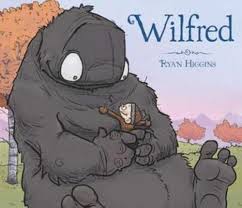
Wilfred, by Ryan Higgins

Published October 22, 2013 by Dagmar

This book hit a home run with my second graders.  It’s a story of friendship and loyalty.  I absolutely love the suspense that kept my students on the edge of their seats.  My students were engaged from the moment I started reading.  This is a great book with wonderful illustrations, and is one of my favorites of the new picture books I bought for this year.

WilfredWilfred is a (very cute) big hairy giant who wants a friend.  He goes to a village and scares everyone, except a brave boy.  He and the brave boy become fast friends.  However, the village is a village of bald people who covet the big hairy giant’s fur.  They ask Wilfred for his fur, and good-hearted Wilfred gives it to them.  Now, freezing in the cold winter, Wilfred can’t come out and play.  He has to stay in his cave to keep warm by a fire.  The boy, searching for his friend, gets lost in a snow storm.  Wilfred hears his cries and leaves his warm cave to try to save the boy.  The villagers find Wilfred and the boy in the snow. Wilfred is wrapped around the boy, trying to keep him warm.  Seeing this incredible act of loyalty, they realize that Wilfred is a good giant who needs his fur back.

You won’t regret buying this book.  Enjoy.

I’m Bored, by Michael Ian Black

Published October 2, 2013 by Dagmar

What a great way to start a school year.  We opened our library officially two weeks ago.  After moving through establishment of rules and learning where books are, we finally pulled out all the new pictures books that I’ve been dying to read to classes.  Here’s the first big winner of the year.Im bored

I’m Bored doesn’t have a lot to say, but what it says makes kids laugh.  Illustrator Debbie Ridpath Ohi’s drawings make the sparse book even funnier.  The book begins with a girl saying, “I’m bored.”  She is soooooo bored.  Then, she finds a potato.  Imagine her surprise when the potato tells her, “I’m bored.”  The girl invites potato to do something, but he only likes flamingos.  Soon, she is trying to convince the potato that kids are actually fun.  She tries just about everything under the sun to convince the potato that kids are fun.  Each time, the potato (and my whole class) says, “I’m bored.” She finally stomps away.  The potato turns, only to find a flamingo.  A flamingo?  Now the potato is ready for some fun – until the flamingo tells him, “I’m bored.”  This last dry line just kicks it.  It might feel like a long buildup to this final punch line, but my students didn’t think so.  They loved the book and immediately wanted to check it out.  Of course, here it sits in front of me as I write.  It will be on the shelf tomorrow!

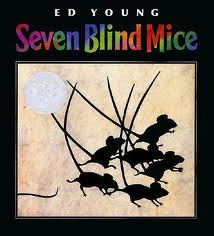
Seven Blind Mice, by Ed Young

Published July 2, 2013 by Dagmar

seven blind miceThis Caldecott Honor book is a favorite with my young readers.  I usually read it to pre-k through 1st grade.  The colors are brilliant, set on a black background.

Seven mice, red, green, yellow, purple, orange, blue and white, try to understand the large object in front of them.  Each one feels a different part of the whole and makes a guess as to what the object must be.  It isn’t until the seventh mouse runs “up one side, down another and across the Something from end to end” that he discovers that the “Something” is an elephant.  The others, then do the same and agree with the white mouse.   The moral? “Knowing in part may make a fine tale, but wisdom comes from seeing the whole.”

The Z was Zapped, by Chris Van Allsburg

Published June 27, 2013 by Dagmar

the z was zappedI’m a fan of Chris Van Allsburg’s work, particularly of The Garden of Abdul Gasazi.  I save most of his books for my older students, so finding a book that my younger students can enjoy is great.  As always, there are incredible black and white illustrations and just a touch of dark humor in the book. This is definitely a different kind of alphabet book. 😉

In the Z was Zapped, the entire alphabet, presented in “a play in 26 acts”, meets its demise on stage.  “The A was in an avalanche.  The B was badly bitten.  The C was cut to ribbons…”  It’s fun watching my students guess at how each letter meets its end.  This was perfect for my 1st graders.

Don’t Let the Pigeon Drive the Bus, by Mo Willems

Published June 26, 2013 by Dagmar

Pigeon busWhatever you do, DON’T let the pigeon drive the bus.  Mo Willems has a great sense of humor, and this book is simply hilarious.  There is not one class, pre-k through 5, that doesn’t laugh hysterically when I read this book.

Pigeon really wants to drive the bus.  But, the only thing the bus driver as asked you to do is NOT let pigeon drive the bus.  Sounds easy, right?  Well, pigeon really, really wants to drive this bus.  He’ll tell you just about anything to get to drive the bus.  Any adult that’s been around a child will recognize Pigeon’s ploys as he tries to cajole you into letting him drive the bus.

Enjoy!  You may just be laughing as loud as the children around you.

This book won a Caldecott Honor in 2004.

Big Mean Mike, by Michelle Knudsen

Published June 8, 2013 by Dagmar

Big Mean MikeWow did my students love this book!  It’s a lot of fun, and the illustrations by Scott Magoon are great.

“Big Mean Mike was the biggest, toughest dog in the whole neighborhood.”  He has the meanest looking car and really mean looking combat boots.  When he opens his trunk to put in a package, there is a bunny – a really, really cute little bunny.  Nothing is less big and mean than a really, really cute bunny.  Big Mean Mike, puts it on the ground and drives away.  The next day, the cute bunny is back with a friend.  Big Mean Mike again leaves the bunnies on the sidewalk and drives away.  This continues until the day that Big Mean Mike goes to the monster truck show.  He then finds four really adorable bunnies under the driver’s seat of the car.  He leaves them in the car to go into the truck show, but then just can’t leave those incredibly cute bunnies in the car.  So, he sneaks them into the monster truck show.  Eventually, he can’t resist their cuteness and lets them out of their bag to watch the show.  As you might suspect, the other dogs tease him when they seem Big Mean Mike with four little bunnies.  This is the best part of the book… The bunnies growl back at the dogs that are teasing Big Mean Mike.  Then, Big Mean Mike tells those dogs that he can be friends with whomever he wants.

This book is so great.  I love the Big Mean Mike has a soft side and that he’ll stick up for himself when he does something that other dogs would be afraid to do.  Go Big Mean Mike!  Go Bunnies!

The Paper Crane, by Molly Bang

Published June 5, 2013 by Dagmar

the paper craneThis book never fails to please my students.  I usually read it to second or third graders, but it can be enjoyed by older students as well.

This is a story of a man who owned a restaurant on a busy road.  He loved owning his restaurant and had many customers, until a new highway was built.  Travelers no longer passed by, and the restaurant was empty.  One evening, a stranger wearing old and worn clothes comes to the restaurant.  Although the restaurant owner is very poor, he feeds the stranger. The stranger repays the kindness of the restaurant owner by folding a napkin into a paper crane.  He tells the restaurant owner that when he claps his hands, the crane will come to life and dance.  Sure enough, it works.  The crane dances.  People come from all around to see the dancing crane and soon the restaurant is busy again. One day, the stranger returns and takes out a flute.  The crane comes to life and goes to him.  Together, they leave the restaurant.  The stranger and his crane are never seen again, but travelers still come to the restaurant to hear the story of the stranger and the crane.

The illustrations are cut paper collage.  This book is the winner of the Boston Globe-Horn Book Award for illustration (1986).