Read alouds

All posts in the Read alouds category

The Empty Pot, by Demi

Published April 26, 2014 by Dagmar

empty potMy older students really enjoyed this book.

The Chinese Emperor is looking for someone to succeed him as Emperor.  The Emperor launches a competition.  He provides all the children with seeds to grow.  The child who grows the most beautiful flowers from the seeds will become the new ruler of the empire.

Ping is a child who not only loves flowers but is able to grow beautiful flowers.  When he receives his seed, he plants it and cares for it every day.  Unfortunately, nothing grows.  Ping replants the seed in a new pot.  He changes the soil that the seed is planted in, and still nothing grows.  The children around him are all able to grow beautiful flowers.  When it is time for the children to present their flowers to the Emperor, they laugh at Ping and tell him that he can’t present an empty pot to the Emperor.  Ping’s father overhears the other children and tells Ping that it’s fine to present his best efforts to the Emperor.

On the day that the children present their pots, Ping approaches the Emperor with his empty pot.  The Emperor, much to everyone’s surprise, smiles.  Ping was the only child unable to grow the seed he was given by the Emperor.  Since the Emperor had boiled the seeds before he gave them to the children, not one of the seeds should have grown.  Ping was the only child who was honest about trying to grow only the seed he was given by the Emperor.  Because of his honesty, the Emperor crowns Ping the new Emperor.

My students loved this ending and couldn’t stop talking about how the other children were deceitful and how Ping’s honesty was rewarded.
North: The Amazing Story of Arctic Migration by Nick Dowson

Published April 19, 2014 by Dagmar

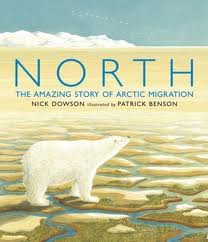
northNorth is a beautiful book describing seasonal changes in the Arctic and Arctic migration.

North begins with winter in the Arctic and its year-round residents, the polar bear and arctic fox.  When spring arrives, algae blooms, plants grow and the tundra turns green.  Animals and birds begin their migration to the Arctic, beginning with the gray whale, terns, bar-tailed godwits, snow geese, white cranes,  caribou, walrus, narwhal whales and more.  The text describes each creature’s journey, including what they eat as they travel.  By May, the ice sheets are cracking, opening new sea lanes for the migrating animals.  In summer the Arctic is lush flowers and grass, feeding the many animals that are now living in the Arctc.  When September arrives, the animals and birds begin to prepare for their journey south again.

It’s a wonderful way to introduce students to migration.  I read it to my 3rd grade students who really enjoyed the book.

Goyangi Means Cat, by Christine McDonnell

Published April 16, 2014 by Dagmar

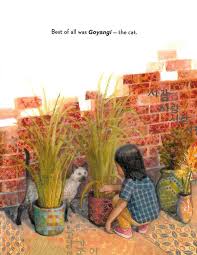
goyangiGoyangi Means Cat is about a young Korean girl, Soo Min, who is adopted by an American family and brought to the United States.  Soo Min knows no English.  Her new family knows only a few words of Korean.  Slowly, she teaches her new parents a few Korean words, including “no”, “hurt” and most importantly the world for “cat”, goyangi.  Soo Min is struggling to adjust to her new life with her new family in America.  She finds comfort petting their cat.  When Goyangi escapes the apartment one day, Soo Min and her new mom look for the cat everywhere.  Goyangi finally returns, and Soo Min, as she hugs Goyangi, says her first English word, “home”.

The author did a wonderful job helping my students understand how hard it was for Soo Min to adjust to her new home and family in the United States and how having a pet like Goyangi was a great comfort to her. We all felt Goyangi’s loss when he escaped and all were so relieved when he returned.


Stuck, by Oliver Jeffers

Published April 10, 2014 by Dagmar

stuckThe easiest books to read to a group of students are funny books.  Oliver Jeffers has written a great book that was a real favorite with my students.

“It all began when Floyd got his kite stuck in a tree…”  Poor Floyd.  When his kite became stuck in a tree, he threw a shoe to loosen the kite.  Sadly, his shoe became stuck, too.  Floyd threw his other shoe and then his cat at the tree to loosen his kite.  Both became stuck.  When Floyd got his ladder, all my students expected that Floyd would climb the ladder to get his kite, shoes and cat.  To their amazement, Floyd threw his ladder into the tree as well. 🙂  It, a bucket of paint, a bicycle, the kitchen sink…an orangutan, a BIG Boat, even the firemen who were sent to help all became stuck in the tree.  The tree was completely full.  So, Floyd got a saw.  As you might expect, Floyd threw the saw into the tree as well; and, finally(!), Floyd’s kite fell out of the tree.  Floyd, happy, walked away with his kite in hand. In bed that night, Floyd wondered if there was anything he forgot to do.  The firemen realizing they might be in the tree for a while, began strategizing about how they might get themselves and everyone else “unstuck”.

This funny and absurd book is a gem.  Don’t miss it!

Journey, by Aaron Becker

Published March 4, 2014 by Dagmar

Journey Journey is beautifully illustrated wordless book and uses color very effectively to tell a story of a good deed and its reward.

As I paged through the book for my classes, I could hear my students whispering the story to themselves.  Their spontaneous applause when I finished the book matched my feelings exactly.  I love this book so much that I’ve shown it to countless adults since first reading it.

A lonely girl takes her red crayon and draws a door in her bedroom wall.  The door leads her into a beautiful forest filled with lanterns and lights.  There she finds a small stream.  She draws herself a boat and follows the stream to a beautiful city.  The city could be from medieval times with its stone walls and golden domes.  She floats through a city canal.  When she comes to the end of the canal, the girl draws herself a hot air balloon.  She flies away and sees a purple bird flying away from city soldiers.  When the soldiers catch the bird and place it in a cage, the girl steals the bird’s cage and frees the bird.  Caught by the soldiers herself, the girl is suspended in her own cage.  The grateful bird brings her a crayon so that she can draw herself a magic carpet.  The girl follows the bird until she finds a door.  When she opens the door…well, you’ll have to read Journey and find out what happens.

This is a book you won’t want to miss and that you and the children you read to are bound to read over and over again.

Snowmen at Night, by Caralyn Buehner

Published February 1, 2014 by Dagmar

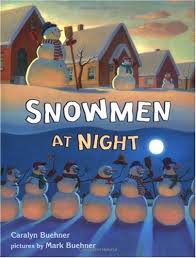
snowmen at nightWhen I moved from New York State to California 30 years ago, I knew that I would give up the seasons and wouldn’t see snow day to day in winter.  Honestly, the latter didn’t bother so much after years of slipping on ice and digging out driveways.

Many of my students rarely, if ever, have the chance to see and play in the snow.  They know that it’s cold in winter, that some trees lose their leaves, that bears hibernate and that children make snowmen and snow angels in the snow.  I love to share winter memories from my childhood in upstate New York, building snow forts with my big brother, making snowmen and throwing snowballs.

Whether your children or students live in a climate where they know winter well, or whether they only can wonder what it’s like, Snowmen at Night is a great book for a winter read aloud.  The rhyming text is easy to read and the pictures by Mark Buehner are so engaging.

What do snowmen do at night? Apparently quite a lot.  “One wintry day I made a snowman, very round and tall.  The next day when I saw him, he was not the same at all!  His hat had slipped, his arms drooped down, he really looked a fright  — it made me start to wonder: What do snowmen do at night?”

This is a fun book about the secret life of snowmen that delighted my kindergartners.  I hope you have fun with it, too.

The Mountain that Loved a Bird, by Alice McLerran

Published January 24, 2014 by Dagmar

themountainthatlovedI was drawn to this book because of Eric Carle’s illustrations.  As I read The Mountain that Loved a Bird, I really fell in love with it, as did my students.  It’s a book filled with longing, friendship and dedication.

Joy is a bird that lands on the side of a mountain.  The mountain is lonely.  When it hears Joy’s beautiful singing it asks her to stay.  Joy says that she can not stay, because there is no food or water for her on the mountain.  She says that she’ll return every year to visit and sing to the mountain.  She also says that she’ll name her daughter Joy and her daughter will name her daughter Joy so that every year bird named Joy will visit the mountain to sing to it.  Each year, Joy returns and each year, the mountain begs Joy to leave and is sad when it’s time for Joy to leave.  One year, the mountain is so sad that it cries, and a stream of tears starts running down the mountain.  The next year, Joy brings a seed with her and drops it near the stream.  Over the course of years, the seed grows roots and draws water from the cracks deep within the mountain.  Soon, more plants grow, and the mountain’s tears of sadness grow into tears of happiness at everything growing around the mountain.  The book closes with Joy bringing a twig to begin her nest on the mountain. She tells the mountain, finally, that she is there to stay.

This is such a beautiful book.  I hope you enjoy it.

Rosie’s Walk by Pat Hutchins

Published January 20, 2014 by Dagmar

Rosie's WalkI do so love an oldie but goodie.  Rosie’s Walk was published in 1968.  Rosie, a hen, is going for a walk.  Little does she realize that there is a hungry fox following her everywhere.  As Rosie walks, fox steps on a rake, falls into a pond, falls into a haystack, has a bag of flour emptied on him and then falls into a wheelbarrow which rolls into bee hives. Rosie completely misses all of the action behind her.  She finally ends up at her chicken coop, just in time for dinner.  Every time I turned the pages, my students would shriek with laughter when they saw what happened to the poor fox.  They were very cute.

I read this to my TK (Transkinder) class, with students who just missed the cutoff for kindergarten.  They absolutely loved this book.  I then tried it with my preschoolers and found that they had a harder time following this book.  I’d recommend it for TK through 1st grade audiences.

So if you’re looking for a quick, funny read for your young students, here it is.

My Brother Martin, by Christine King Farris

Published January 17, 2014 by Dagmar

my brother martinI have some favorite books to read when celebrating Dr. Martin Luther King Jr.’s birthday and his tremendous life.  One, is Martin’s Big Words, by Doreen Rappaport.  Like me, most teachers love Martin’s Big Words as well.  So finding something different but accessible to young audiences is a always a challenge for me in the library.

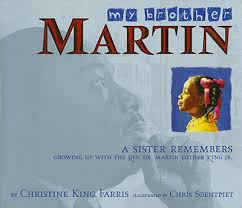
Here is a book that I discovered this year that I love for younger audiences.  Published in 2006, it provides a different perspective on this great man’s life that students haven’t heard before.  When I introduce this book to my students, I remind them that before Dr. King became “Dr. King”, he was a child just like them.  My Brother Martin was written by Christine King Farris, Dr. King’s older sister.

In My Brother Martin, Ms. King Farris tells of Dr. King’s childhood on Auburn Street in Atlanta, Georgia.  There are funny pranks that the children, Christine, M.L. (Martin Luther) and their younger brother A.D. (Alfred Daniel) played on neighbors and their piano teacher.  These stories made all my students smile.  Ms. King Farris also tells of the painful time when the children of a white store owner on their street were no longer allowed to play with Negroes (a word I had to explain to my younger students).  The white family sold their store and moved away.  After years of shielding their children from the injustice and cruelty dealt to black people, this episode brought all that home.  Christine, M.L. and A.D. were confused about why their friends would no longer play with them.  Their mother explained about all the “Whites Only” signs.  She also told her children that this injustice was there, “Because they just don’t understand that everyone is the same, but someday, it will be better.”  M.L. then replied, “Mother Dear, one day I’m going to turn this world upside down.”  And that he did.

M.L. and his sister and brother now were aware of segregation.  They watched as their father, a minister at Ebenezer Baptist Church spoke out against it and how he practiced what he preached.  Their father did not allow others to treat him differently because of his skin color and took his business elsewhere when store owners did.  Their parents’ example and the pain of their childhood friends’ leaving provided the inspiration for Dr. King’s pursuit of justice.

This is a heartening and inspiring story of Dr. King that provides insights other books don’t provide.  I highly recommend it to elementary school audiences.  The illustrations by Chris Soentpiet are wonderful.

Red Sled, by Lita Judge

Published January 12, 2014 by Dagmar

red sledI’m a huge fan of wordless books for kids.  This genre has really grown.  It includes books for young students, like one of my favorites, A Ball for Daisy, by Chris Raschka, and complex and beautiful wordless books like The Arrival, by Shaun Tan, meant for middle schoolers.

Younger students and particularly students who aren’t reading yet get such a feeling of confidence when they can read a story on their own.  In the case of my library, students sit quietly and watch the story unfold as I turn the pages for them.  Sometimes I have them tell me the story that they just “read”.  This time, we just closed the book and smiled.

The Red Sled is not a completely wordless book.  The only words that appear are onamatopoeias. The book opens with a red sled sitting outside a house in the snow.  A bear wanders by and notices the sled.  He decides to take it for a ride, and what a wild ride it is!  Soon, a rabbit joins him, then a moose, then two raccoons, an opposum, a porcupine and a mouse.  The illustrations are wonderful, particularly the animals expressions as they tumble down the hill on the red sled. My students were so quiet as they read the book, then, they started smiling and soon they were laughing out loud.  After the animals finish their sled ride, the bear replaces the sled at the door of the small house.  The child who owns the sled walks out the next day, picks up his sled and notices bear tracks.  The book closes with the child swinging from the antlers of the moose as the animals go on another sled right that night.

This is a sweet, quick book that kids will really love.