Read alouds

All posts in the Read alouds category

There’s a Wocket in My Pocket, by Dr. Seuss

Published December 21, 2013 by Dagmar

Who doesn’t love Dr. Seuss?  I think the most spectacular shrieks of the year came on Thursday when I read, There’s a Wocket in My Pocket, to my K/1 wocketclass.  My students went wild over all the fantastic creatures with names that rhyme with every day household things, like the Ghair in the Chair, the Nink in the Sink.  They were properly spooked by the Vug under the Rug who, let me tell you, has always made the hair stand up on my neck.

This book is not only perfect for beginning readers, this book is also a perfect read aloud for students ready to appreciate some good rhymes.  One student, upon leaving, told me to be careful to check my shelf for a zelf and my book basket for a wasket.  I dutifully checked everything before the student left; and, of course, jumped three feet in the air when I actually saw the zelf and then the wasket.  That made him laugh!

Have fun with this one.

One Fine Day, by Nonny Hogrogian

Published December 7, 2013 by Dagmar

onefinedayThis 1971 winner of the Caldecott Medal worked really well with my kindergarten students.  One day, a fox, traveling through a forest, notices a pail of milk.  He quickly laps up all the milk but is caught by the old lady who owns the pail.  Angry that the fox drank all her milk, the old lady cuts of his tail.  He asks her to please sew it back on so his friends won’t tease him.  She tells him that she’ll sew it back on if he brings her more milk.  So begins fox’s journey to find milk.

The fox meets a cow who won’t give him milk unless the fox gives her some grass.  He goes to the meadow, but the meadow won’t give him grass until she gets water and so on.  Finally, after six different people ask him for something the miller takes pity on the poor fox, giving him some grain to give to the hen so he can have an egg to give to the peddler and so on until he has enough milk to pay back the old woman.  The old woman does finally sew back on the fox’s tail.  My guess is that our fox won’t be stealing milk again. 🙂

Enjoy!

Wild Horse Winter, by Tetsuya Honda

Published December 6, 2013 by Dagmar

wildhorseThis book was a sleeper, sitting for the last three years in a paperback picture book basket.  As I flipped through my basket, organizing books one day, I was intrigued by this book.  You may have read that my first grade students board my library plane each week, taking trips to different continents and countries.  Thinking that this book took place in Wyoming or Colorado, I was already to break out my state books.  The fact that I was rushed and hadn’t read the book before I decided to read it to my students was quickly discovered as the horses in the book inexplicably reached the ocean.  Last time I heard, there are no oceans in Colorado.  My very forgiving students were happy to re-board our plane and head West, all the way across the Pacific Ocean to the island of Hokkaido in Japan.

This beautifully illustrated book by Tetsuya Honda is about the wild horses that live on the island of Hokkaido in Japan.  These horses, according to the author’s note, were brought to the island of Hokkaido three hundred years ago, by merchants and fisherman.  In the winters, the merchants and fisherman would abandon the island to go to the mainland, but left their horses to survive the harsh winter on the island.  In this story, we see a colt and his mother brave the winter by sleeping in a snow drift as they try to find their way from the grassy inland to the ocean.  According to the author, Dosanko horses are known to lie down close to the ground and allow the snow to cover them in an effort to stay warm.  Over many years, yhe horses, known as Dosanko horses, adapted to the harsh winters gradually developing longer hair, shorter bodies and stronger hooves. There are now only about 1,000 of these horses, living mostly on wild horse preserves.

This book was a jumping off point for lots of discussion: about Japan, how animals adapt to harsh conditions, how the native tribes near the arctic circle sometimes use ice to build homes to stay warm and how you might stay warm if caught in a blizzard or avalanche.

The book really captivated my students.  I recommend it for first through third grade audiences, or younger audiences at home.

Nelson Mandela, by Kadir Nelson

Published December 6, 2013 by Dagmar

mandelaYesterday, Nelson Mandela passed away.  He fought for freedom and won it for his people.  He was a tremendous man.  He lived 95 years and is a symbol of the power of protest for so many around the world.  President Obama said, “Let us pause and give thanks for the fact that Nelson Mandela lived–a man who took history in his hands and bent the arc of the moral universe toward justice.”

How lucky for us that we have Kadir Nelson’s beautiful picture book about Nelson Mandela to help children understand the life and work of Nelson Mandela.  The book, written in verse, leads the reader through Nelson Mandela’s life from the time he was a child through the end of apartheid and his election as South Africa’s first black president.  The illustrations are full-page and incredible in the way that they capture the emotion of each scene.

On the back cover of the book, the author says, “My work is all about healing and giving people a sense of hope and nobility.  I want to show the strength and integrity of the human being and the human spirit.”  He certainly succeeded in this book.

Highly recommended.  Best for third grade and up, but could work for younger students as well.  Thank you to Junior Library Guild for introducing me to this book.

Chu’s Day, by Neil Gaiman

Published November 21, 2013 by Dagmar

Chu's DayHere’s a fun one for the pre-k-kindergarten set.  Neil Gaiman, Newbery award-winning author of The Graveyard Book, is back with a very cute picture book about a little panda that has to sneeze.  What really makes this book, though, are the incredibly colorful and rich illustrations by Adam Rex, reminiscent to me of Pete & Pickles, a real favorite of mine and with older students in my library.

When Chu sneezes, bad things happen.  Chu visits the library with his mom and looks like he needs to sneeze.   When he visits the diner with his dad, he looks like he needs to sneeze.  My students appreciated my theatrical “almost sneezes” and then laughed when adorable Chu said “No,” he didn’t have to sneeze.  Then, Chu and his parents visit the circus – you know – then one with the really big tent?  Chu tries and tries to tell his folks, who are enthralled by the circus, that he needs to sneeze.  No one listens.  Oops.  That sneeze not only knocks down the circus tent, but also everything in the library and diner too, much to the delight of my students.

If you’re looking for a hit with your younger students, you’ll enjoy Chu’s Day.

Lesson idea: Whales, Oceans and The Snail and the Whale

Published November 3, 2013 by Dagmar

whale and the snailThis is a lesson I’d wish I’d done earlier in the year, because the book I chose to feature in this lesson is about a snail who is itching to travel and see the world. That’s just the sentiment that I want to inspire in my own students.

This week in our library journey, my first graders and I became whales and traveled the world’s oceans.  We finished our trip by reading the fabulous book, The Snail and the Whale by one of my favorite author’s, Julia Donaldson, author of Room on the Broom.

photo(5)It was very fun to become whales.  Using the Oceans Alive of the Blastoff! Readers series, published by Bellwether Media, we learned about whales.  Oceans Alive We held up our arms with our hands together like whale tails and swam by moving our big whale tails.  We learned that our hands were called flukes and loved breaching and blowing air out of our blow holes.  We put out our arms and learned that whales steer and stop with their fins.

If time permits, this is also a perfect time to learn about oceans.  Using another set from the Blastoff! Reader seriesphoto(6), Learning about the Earth, we learned that oceans cover most of the earth, that ocean water is salty, that there are different kinds of coasts and talked about the concepts of shallow and deep and different animals that live in the ocean.
In the Snail and the Whale, a snail with an “itchy foot” wants to travel through the world’s oceans and decides to hitch a ride on a whale.  Together, they travel until one day, the whale gets confused by motor boats in a bay and is beached on a shore.  The quick thinking snail goes to a school and leaves a message on a classroom chalkboard, “Save the Whale!”.  Quickly, students, teachers and the whole town come to save the whale.  The whale is saved.  Together the Snail and the Whale return to the rock where they found each other only to take off again with all the snails on the whale’s tail, ready to see the world.

Update: This year, I used books but added a second week of whale books with a great, suspenseful book called Humphrey the Lost Whale, the True Story of Humphrey, a humpback whale who swam under the Golden Gate Bridge into San Francisco Bay and up the Sacramento River in the 1980s.  My students absolutely loved this book by Wendy Tokuda.  Another companion book is Baby Beluga, the “song” book by Raffi.  We read and sing Baby Beluga every year in kindergarten. so it’s nice to bring it back while we’re learning about whales.

The Snail and the Whale, by Julia Donaldson

Published November 3, 2013 by Dagmar

I was so happy to find this book at my local bookstore.  I knew it would be a hit the minute I saw it.  I love Julia Donaldson’s  book, Room on the Broom, also illustrated by Alex Scheffler. Like the rhymes in Room on the Broom, the rhymes in this book are great, not forced or tiresomwhale and the snaile, and Alex Scheffler’s illustrations, wonderful.  It’s a story of curiosity, adventure and friendship that you won’t want to miss.  Be sure to check out my lesson idea using this book.

The Snail and the Whale is about a snail who sits on a rock with lots of other snails but dreams of traveling the world.  The other snails mock him, but this snail is determined to go on an adventure.  He writes “Ride Wanted Around the World” on the rock.  Soon, a whale arrives, offering to take the snail around the world.  Together they travel the oceans, seeing icebergs, “fiery mountains” and “golden sands”.  Until one day, confused by speed boats in a bay, the whale is beached.  The snail, though small, thinks of a plan.  He makes his way to a school where he writes “Save the Whale” on a chalkboard.  All the school children mobilize the town’s firefighters to help the whale swim back to sea.  Once saved by the children, the Snail and the Whale return to ocean and the rock where their journey started.  Once there, they tell the story of their adventures to the other snails.  The book closes with the whale once again leaving the rock, but this time, with all the snails on his tail.

My first graders really loved this book.  I think it’s great for read alouds to kindergarten through second grade classes and even younger readers at home.

Wilfred, by Ryan Higgins

Published October 22, 2013 by Dagmar

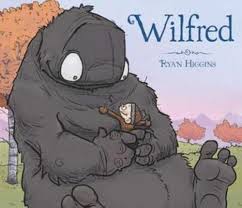
This book hit a home run with my second graders.  It’s a story of friendship and loyalty.  I absolutely love the suspense that kept my students on the edge of their seats.  My students were engaged from the moment I started reading.  This is a great book with wonderful illustrations, and is one of my favorites of the new picture books I bought for this year.

WilfredWilfred is a (very cute) big hairy giant who wants a friend.  He goes to a village and scares everyone, except a brave boy.  He and the brave boy become fast friends.  However, the village is a village of bald people who covet the big hairy giant’s fur.  They ask Wilfred for his fur, and good-hearted Wilfred gives it to them.  Now, freezing in the cold winter, Wilfred can’t come out and play.  He has to stay in his cave to keep warm by a fire.  The boy, searching for his friend, gets lost in a snow storm.  Wilfred hears his cries and leaves his warm cave to try to save the boy.  The villagers find Wilfred and the boy in the snow. Wilfred is wrapped around the boy, trying to keep him warm.  Seeing this incredible act of loyalty, they realize that Wilfred is a good giant who needs his fur back.

You won’t regret buying this book.  Enjoy.

The Girl Who Spun Gold, by Virginia Hamilton

Published October 18, 2013 by Dagmar

thegirlwhospungoldRumpelstiltskin is a favorite Grimm’s fairytale.  The Girl Who Spun Gold, by Virginia Hamilton retells the story in a West Indian setting. This refreshing version captivated my fourth graders not only because of Hamilton’s writing, but particularly because of Leo and Diane Dillon absolutely captivating, colorful illustrations.  Hamilton read a version of this tale in West Indian dialect in 1899.  While she loved the retelling, she found it hard for modern audiences to understand.  So, she re-wrote it in more familiar language.  The version is long and took longer than one class time to complete, but was well worth the time.  Click here to see a lesson idea comparing two different retellings of the Rumplestiltskin story using this book.

Lesson idea: The Girl Who Spun Gold and Rumplestiltskin

Published October 18, 2013 by Dagmar

Here’s a lesson idea, contrasting two different retellings of a fairy tale, that worked really well with my fourth graders.  I love the book The Girl Who Spun Gold, by Virginia Hamilton and wanted to pair it with the traditional telling of Rumplestiltskin.  I used a very old copy of Rumplestiltskin thegirlwhospungoldthat we had in our library.  I wasn’t thrilled with this older book and ordered Paul Zelinsky’s version of the book after this lesson (winner of the 1987 Caldecott Honor).  The illlustrations are full of vibrant color that are sure to attract students and compare nicely with Leo and rumplestiltskinDiane’s illustrations in The Girl Who Spun Gold.

I took two class times to read Virginia Hamilton’s book, about 20 minutes, in all.  I then read the traditional telling of the story.  My students were jumping up to offer me similarities and differences between the two retellings of the story.  It was a lot of fun to see them so excited.

Next week, I’ll do a book talk and read the first couple of chapters of Rump: The True Story of Rumplestiltskin, a new book by Liesl Shurtliff, a fractured fairytale.