Read alouds

All posts in the Read alouds category

The Really, Really, Really Big Dinosaur, by Richard Byrne

Published May 9, 2013 by Dagmar

big dinosaurThis was a fun read.  Here’s your opportunity to use different voices, if you’re so inclined.  The illustrations are really cute and it was great watching my students smiling and then clapping at the end of the book.

Big dinosaur wants little dinosaur’s jelly beans.  Little dinosaur can’t give them away, because they belong to his friend.  Big dinosaur really wants those jelly beans… a lot.  The little dinosaur says his friend is really, really, really big. “Everyone knows I’m the biggest and strongest dinosaur around here!” Big dinosaur starts boasting about all the ways he is better than little dinosaur’s friend. Ooops. Big dinosaur gets his just desserts in a very funny way.
I Want My Hat Back, by Jon Klassen

Published May 5, 2013 by Dagmar

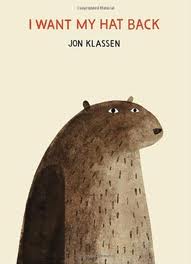
IwantmyhatbackI just love this book.  Jon Klassen is a fantastic illustrator.  His illustrations are quite distinctive.  While this book looks really simple, the humor is dry and there is just that touch of darkness that older readers love.

“My hat is gone.  I want it back.”  A big bear is looking for his pointy red hat.  He asks lots of animals if they’ve seen his hat.  A rabbit wearing a red, pointy hat suspiciously answers the bear’s query by saying that he did not steal a red hat.  The book goes on until the bear remembers where he saw his hat.  I won’t tell you what happens next, but let’s just say that the bear gets his hat back.

Such a great book.  Enjoy!

The Pencil, by Allan Ahlberg

Published May 5, 2013 by Dagmar

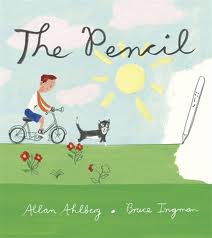
“Once there wThePencilas a pencil, a lonely little pencil, and nothing else.”  So begins the pencil’s drawing career.  First he draws a boy, named Banjo, then a dog, named Bruce.  When the boy asks the pencil to draw a cat, the pencil hesitates – and rightly so.  The dog chases the cat, named Mildred.  The cat asks for a mouse.  The Pencil says “no”.  The pencil draws a paintbrush, named Kitty, that colors everything in.  It’s not long before everyone the pencil draws needs something or complains about something.  So, the pencil cleverly draws… an eraser.  But then the eraser goes crazy and erases absolutely everything…until the pencil draws another eraser.  They were named Ronald and Rodney.

This very funny book was illustrated by Bruce Ingman.  Highly recommended for older readers.

First the Egg, by Laura Vaccaro Seeger

Published May 4, 2013 by Dagmar

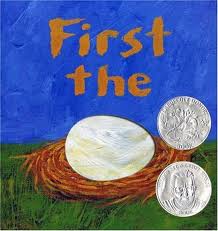
FirsttheeggThis is a Caldecott Honor Book and a Theodor Seuss Geisel Honor Book. I am drawn to this book, because the simple life cycle concepts and great illustrations.  The illustrations appear to be oil paint on canvas.  Not only are the colors really vibrant and attractive, but cut outs on the page create additional visual interest.

The book starts with “First the Egg” and on the next page “then the Chicken”.  Each life cycle covers three stages, so we start with the egg, then then chick, then the chicken.  The book goes on to include frogs, flowers and butterflies.  I like the page that turns words into stories and paint into pictures.  The final page brings the book full circle by saying “First the chicken” followed by “First the Egg”.

This book makes an great read aloud, because there are so many opportunities to interact with students.  I really like that the book shows three stages of the life cycle.  I highly recommend this book for prek through first grade as a read aloud.

Aesop’s Fables, by Jerry Pinkney

Published May 2, 2013 by Dagmar

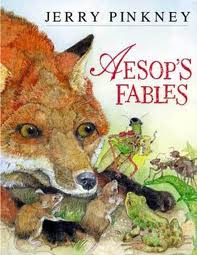
Caldecottaesop-winning author and illustrator Jerry Pinkney’s Aesop’s Fables appear with Pinkney’s incredible illustrations.  I’ve seen a many versions of Aesop’s Fables and can honestly tell you that this is my favorite version.

It’s hard to deny the appeal of fables to children.  My students tend to want to read the most familiar fables, “The Shepherd Boy and the Wolf”, “The Tortoise and the Hare” and the “The Lion and the Mouse”; but, there are so many wonderful fables to explore in this book.  I love that this book appeals to children of all ages.

The Lion & the Mouse, by Jerry Pinkney

Published May 2, 2013 by Dagmar

lionThis Caldecott Medal winning book is superb.  I have always been a fan of Jerry Pinkney’s illustrations, but this book is truly beautiful.  The Lion & the Mouse is a wordless retelling of  Aesop’s fable of a lion who spares a mouse’s life and then has his life saved by the mouse.  The moral of the story? “Even the strongest can sometimes use the help of the smallest.”

The illustrations in this book are breathtaking.  I love watching my students intently look at each page and then listening as they recount the story to me.  Pinkney says in his author’s note at the end of the book, “My curiosity and reverence for animal life has grown over the years, and my concern for them grows in equal measure.  It seemed fitting, then to stage this fable in the African Serengeti of Tanzania and Kenya, with its wide horizon and abundant wildlife so awesome yet fragile – not unlike the two sides of each of the heroes starring in this great tale for all times.”  It is clear that Pinkney loves animals, because I honestly believe that the detail is so wonderful in these pictures, that I can read the animals’ expressions.

This is a book that would be an incredible addition to any child’s library.

Swirl by Swirl, Spirals in Nature by Joyce Sidman

Published May 2, 2013 by Dagmar

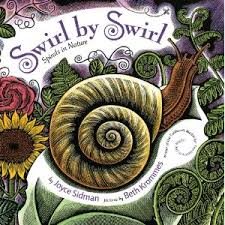
This swirlmay be one of the most beautiful books in my library.  Swirl by swirl is full of illustrations by Beth Krommes (winner of the Caldecott Medal for The House in the Night)  that look as if they have been etched.  The colors are vibrant and really “pop” against the black background.  I use this book with my older grades to show them the incredible art work and talk about seeing shapes in nature.  I use the book in my younger grades to show the students all the ways that swirls exist in nature.  Either the way, the book is always a hit and would make a great gift for any young child at all interested in nature.  The words are simple, but the concept has lots of room for discussion.

“A spiral is a snuggling shape.  It fits neatly in small spaces.  Coiled tight, warm and safe it waits.”  The pictures show a woodchuck, an eastern chipmunk and a bull snake curled up in their burrows underground. “A spiral is a growing shape.  It starts small and gets bigger, swirl by swirl.”  This page includes a swimming nautilus and a cross section of a nautilus shell.  As the book progresses, we see ferns, snails, hedgehogs, millipedes, the horns of rams, octopi, seahorses, elephants’ trunks, spider webs, ocean waves, flowers, the Milky Way.  There are endless things to talk about.

This is an incredible book worthy of any school library or any bookshelf at home.  It’s a favorite of mine.  I hope you enjoy it!

One Grain of Rice, by Demi a mathematical folktale

Published May 1, 2013 by Dagmar

one grain of riceThis book is a mathematical folk tale.  It also happens to be a great read aloud book, especially for third grade.  Even the most fidgety child is amazed and applauds at the end of the book.  I love the colorful drawings.

Once there was a greedy raja in India who asked all of his subjects to give him nearly all of their rice, so he could store the rice safely in case there came a famine.  However, when the famine came, the raja kept all the peoples’ rice for himself.  One day, a young woman was gathering rice that had dropped from the raja’s baskets onto the road.  She was arrested for stealing and brought before the raja.  The girl, named Rani, cleverly told the raja that she was simply returning the rice to him.  He was pleased and granted her one wish.  She asked him to give her one grain of rice and then double the grains of rice every day for thirty days.  The raja, clearly not clever at math, readily agreed, thinking Rani a fool.  Little did the raja suspect that in thirty days, one grain of rice on day one would result in his giving more than one billion grains of rice by day thirty.  Asking Rani what she would do with the rice she received, Rani replied that she would feed the hungry.  The raja then mended his ways and became a truly wise and fair raja.  The best part of reading this book aloud is always the  “oohs and aahs” I get when I fold out page at the end of the book, showing the 256 elephants it takes to carry the millions of grains of rice the raja had to deliver.

If I Never Forever Endeavor, by Holly Meade

Published April 27, 2013 by Dagmar

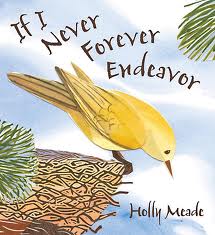
If you knowIf I Never a child that is struggling with taking risks or overcoming a fear, this is an inspiring book.  I share this with my grades, 2nd through 6th but think it works best with 2-4th graders.  I had a great experience reading it to my third graders recently.  They were drawn in by the words, written in verse, and the simple but beautiful illustrations of a yellow bird, green trees and a blue sky.

“If in all of forever, I never endeavor to fly, I won’t know if I can…I won’t know if I can’t.  On the one wing, I could try and find that I flap and I flail, flounder and plummet, look foolish and fail.  On the other wing, I could try and take flight…If I did endeavor, and found my wings clever, I could see the world! Or get lost in it.”

I think this book really works with kids, because it acknowledges the fears that come with taking risks but also explores the possibilities and opportunities if risks are taken.  After I read this book, we had a great discussion as a class of times when students took risks.  They also talked about risks they were still scared to take.  I love this book, because it is thought-provoking at the same time it is comforting and uplifting.

Ginger, by Charlotte Voake

Published March 15, 2013 by Dagmar

A sweet book about adapting to change.www.ginger

Ginger is a ginger-colored kitty who is pampered by the little girl he lives with.  She makes him delicious meals and gives him a nice basket.  He’s very happy, until…a little kitten joins the household. The kitten upsets Ginger by eating out of his food bowl and trying to call into his basket.  Ginger is so upset that he decides to leave home.  The kitten misses him and gets into all kinds of trouble.   The little girl finally realizes that Ginger may be upset and might have run away.  She finds him outsie in the rain, sitting alone under a bush.  After bringing Ginger in, the little girl makes sure that Ginger has his own bowl and his basket back.  The kitten gets his own cardboard box to sleep in.  What a sweet ending when the little girl finds Ginger and the kitten in the cardboard box together.  The book’s large type and simple theme makes this book great for young students and anyone who loves cats.